


Rubber flooring isn’t just for gyms and playgrounds anymore. Below are 7 places where it beats traditional flooring (marble, laminate, vinyl) in ways most people never think about.
1. Rubber Flooring vs. Tiles
Traditional tiles are tough, yes they can handle heavy foot traffic and years of wear without cracking. But that toughness comes at a cost: every footstep, dropped object, or dragged chair echoes across the room. In a home with kids, pets, or a busy household, that noise adds up fast.
Rubber flooring solves this in a way tile simply can’t. Because rubber is naturally elastic, it flexes slightly under pressure instead of transmitting the full impact straight through to the subfloor. That means less noise, less vibration, and a surface that feels noticeably softer underfoot a real difference if you’re standing in the kitchen for long stretches or have a home gym tucked into a spare room.
There’s also the budget side of things. Tilework isn’t just about the tiles themselves it’s the labor-intensive installation, the grouting, the potential for cracked or chipped pieces down the line that need replacing. All of that adds up, and it’s easy for a tiling project to blow past your renovation budget before you’ve even finished a single room. Rubber flooring, by contrast, comes in a much wider range of price points, so you can scale the investment to match your space and your budget without compromising on durability.
Maintenance is where rubber really pulls ahead, especially in Dubai’s climate. With dust and sand finding their way indoors year-round, and humidity swings that can make some flooring materials warp or discolor over time, rubber holds up well. A quick sweep and an occasional mop is usually all it takes to keep it looking new no sealing, no special cleaners, no re-grouting every few years.
2. Rubber Flooring for Kitchens
Think about being on your feet cooking dinner after a long day, shifting between the stove and sink, prepping, plating, cleaning up, and doing it all over again the next day. Hard surfaces like tile or stone don’t give at all, which means your joints absorb every bit of that impact. Over time, standing on unforgiving flooring for hours a day takes a real toll on your feet, knees, and lower back.
This is exactly where rubber flooring earns its keep. Its natural cushioning absorbs impact instead of pushing it back up into your body, so there’s noticeably less strain on your joints. You’ll feel the difference within minutes of standing on it it’s the kind of upgrade that doesn’t show up in photos, but you notice every single day.
Then there’s the mess factor, and in a kitchen, mess is inevitable. Rubber handles spills, dropped knives, or bowls without cracking, chipping, or staining something tile and hardwood can struggle with over time. Accidents happen, and rubber simply shrugs them off.
Safety matters just as much as comfort. Kitchen floors are constantly exposed to water, oil, and general spills, and a slippery surface is a real hazard, especially in a busy household. Rubber flooring’s textured surface grips well even when wet, which means fewer slips and a lot more peace of mind while you’re moving quickly between the stove and sink.
So yes not only can you use rubber flooring in your kitchen… you probably should.

3. Rubber Flooring for Toddlers and Kids
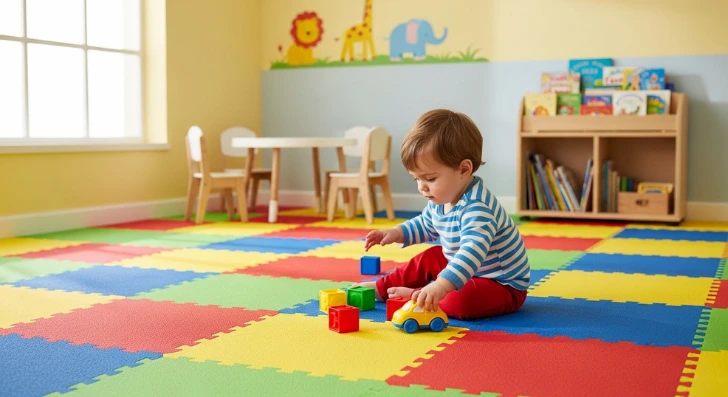
When it comes to flooring for kids, you need more than just good looks you need peace of mind. Kids fall constantly. They crawl, stumble, jump off couches, and test the limits of every room in the house, and the last thing you want is a hard, unforgiving surface waiting underneath them.
Rubber flooring is soft and slightly cushioned, which makes a real difference for a toddler learning to crawl and eventually take those first wobbly steps. Falls that would sting on tile or hardwood are far gentler on rubber, giving both kids and parents a little more breathing room during that clumsy, exploratory stage.
Now let’s talk about health. Traditional tiles rely on grout lines, and grout lines trap dust, allergens, and grime in ways that are genuinely hard to clean, no matter how often you scrub. Rubber flooring, by contrast, is a seamless surface with nowhere for dust or debris to hide, so a quick wipe-down keeps it genuinely clean rather than just clean-looking.
4. Rubber Interlocking Tiles for Garages
Absolutely, rubber flooring makes total sense in your garage.
See, tiles look good until the first tool drops or the oil drips. Garages take a beating heavy toolboxes get dragged across the floor, car jacks and equipment get dropped, and oil or fluid stains are practically a given. Ceramic or porcelain tiles simply aren’t built for that kind of abuse; a single hard impact is often enough to crack or chip them, and once that happens, the damage is permanent and visible.
Rubber flooring stays intact under exactly the kind of punishment a garage dishes out daily. It absorbs impact instead of cracking under it, resists oil and chemical stains, and holds up to constant foot and wheel traffic without wearing down.
Rubber interlocking tiles are made for this purpose specifically. Their modular design means you’re not committed to one giant, continuous surface the floor is built from individual sections that click together.
That modularity is what really sets this option apart. Because if a section ever gets damaged? You don’t replace the whole floor. Just lift and swap the affected piece, and you’re done in minutes rather than dealing with a full re-installation.

5. Rubber Flooring for Basements
Rubber offers a softer surface underfoot.
Basements come with a unique set of challenges, and moisture is usually the biggest one. Tiles can soak up ground-level moisture that seeps in from below, and over time that trapped dampness starts showing up as mold or a musty smell that’s hard to get rid of once it sets in.
Rubber floors naturally resist water and don’t hold onto dampness the way porous materials do. That means no mildew forming underneath the surface, no warped or discolored grout lines to deal with, and no sneaky leaks slowly working their way into your subfloor before you even notice there’s a problem.
It also acts as a subtle insulator, which matters more than people expect. Basements often sit close to the ground, and depending on the building, that can mean the floor picks up heat or cold straight from the earth beneath it. So even if your basement sits right on top of the Dubai sand, the flooring won’t feel like you’re walking barefoot on hot sand rubber creates just enough of a buffer to keep the surface feeling neutral underfoot, no matter what’s happening below it.
On top of that, the softer surface makes the basement feel more livable day to day, whether it’s being used as a storage space, a home gym, or an extra living area you’re not stepping onto cold, hard ground every time you head downstairs.
6. Can Offices or Studios Benefit from Rubber Flooring?
Yes, they can, and they do it very well.
Unlike cold, echo-prone tiles, rubber flooring naturally absorbs sound rather than bouncing it around the room. In open offices or content studios, where every footstep, rolling chair, or dropped object can break someone’s concentration, that difference matters more than people expect. Rubber acts like a built-in noise filter, quietly cutting down on the ambient clatter that makes open-plan spaces feel chaotic by mid-afternoon.
Comfort is the other half of the equation. Standing desks might be great for posture, encouraging you to move and avoid the slouch that comes with sitting all day, but standing on a hard floor for hours takes its own toll on your feet and lower back. Anti-fatigue rubber mats solve that problem directly, providing just enough give to keep your legs from tiring out, so your energy levels stay higher through long hours of work or production instead of dropping off after lunch.
And no it doesn’t look like a recycled gym mat anymore. We offer rubber flooring in modern finishes with clean textures that suit a professional setting, not just a warehouse or gym. You can also get wood-like tones that mimic the warmth of hardwood without sacrificing any of rubber’s practical benefits. It blends well into offices, studios, and any workspace that wants to look polished while still being functional.
7. The Smarter Outdoor Surface
Rubber flooring is the best choice for outdoor spaces compared to tiles or marble. Rubber mats don’t turn your patio into a frying pan by noon. Many modern rubber options won’t fade under harsh sunlight. And when it comes to safety, rubber wins again.
Even during a dusty morning or after watering your balcony plants, the surface remains slip-resistant. So whether it’s a shaded terrace in Jumeirah or a high-rise balcony in Marina. Anti-slip rubber flooring gives you the comfort and the grip… without sacrificing style.

FAQs.
Q1. Is rubber flooring more durable than tiles?
Yes, rubber flooring is far more durable than tiles. It resists cracks and doesn’t chip from sides easily. Plus, it handles moisture better, making it ideal for both homes and commercial zones.
Q2. Can rubber flooring be used in Dubai weather?
Rubber flooring holds up really well in Dubai’s climate. It doesn’t get damaged by heat or direct sunlight, so it works just as well outdoors as it does indoors, even during peak summer months.
Q3. Does rubber flooring look cheap?
Not anymore. Newer rubber flooring comes in textured finishes, sleek matte looks, and even wood or stone-style patterns. They blend well with modern homes and gym interiors.
Q4. How do you clean rubber floors?
Cleaning rubber flooring is simple. You don’t need any chemicals – just a mop or vacuum works fine. It doesn’t stain easily, and you won’t have to worry about damage from spills or dirt either.
Q5. Is rubber eco-friendly?
Yes, most rubber floors are made from recycled materials like old tires. Once used, they can be recycled again, which means they help reduce landfill waste and support a more eco-friendly lifestyle.


