


Choosing the right rubber gym flooring thickness isn’t just about comfort—it’s about safety, performance, and protecting your investment. Here’s how to get it right from day one.
Why Thickness Matters More Than You Think
When it comes to gym flooring, thickness isn’t just a number on a spec sheet.. It’s the actual foundation of your training environment. The right thickness protects your joints and prevents your floors from long-term damage. Thicker rubber mats make workouts more comfortable for you and less disruptive for others.
What Factors Decide the Ideal Thickness?
Selecting the right thickness should never be guesswork.
Type of Workouts
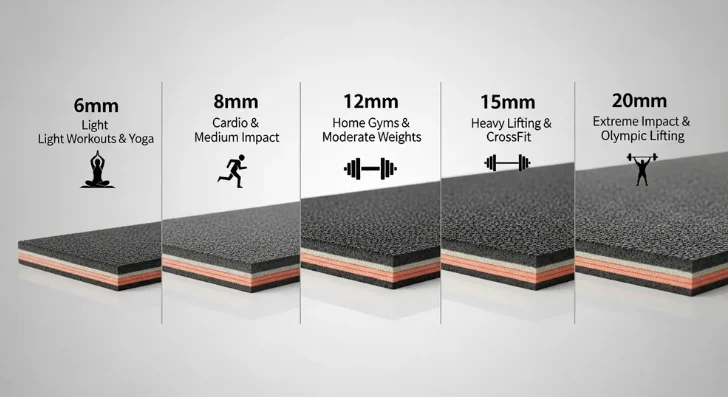
If your sessions are mostly light cardio, stretching, or yoga.. Then select 6-8mm range will do the job. For CrossFit, or weight lifting, you’ll need thicker mats that can absorb heavy impacts.
Equipment Weight
A treadmill, squat rack, or heavy dumbbell set will exert more pressure on the floor compared to a yoga mat or resistance bands. Heavier equipment calls for thicker flooring.
Frequency of Use
A home gym used three times a week has different demands than a commercial space with back-to-back clients all day. The more frequently you use it, the more you should invest in.
Rubber Flooring Thickness For Different Training Levels
Beginner Level. Light Training
If your workouts are mostly yoga sessions, Pilates, stretching, or light dumbbell exercises, flooring between 6mm and 8mm is enough. It offers a comfortable surface for movement without adding unnecessary bulk or cost. This thickness also works well for small home setups where space efficiency matters.
Intermediate Level. Mixed Training
For those who combine cardio, functional training, and regular use of free weights, the sweet spot is 8mm to 12mm. This range offers stronger impact absorption, better durability, and enough protection for both your joints and your flooring. It’s a versatile option for both home and light commercial use.
Advanced Level. Heavy Lifting
When the training involves Olympic lifts, heavy power racks, or constant use of large machinery, you’ll need 15mm to 20mm or more. At this level, flooring acts as serious shock protection, shielding the subfloor from repeated heavy impacts while reducing noise and vibration.
This is the standard in high-performance gyms and professional training facilities.
Popular Rubber Gym Flooring Thickness Comparisons
When making a choice on the thickness of your gym flooring, you need to consider not only the kind of exercise you will be performing but also your budget, space, and the ability to last a long time.
6mm – Suits well to light exercises, stretching floors, and areas of the installation where the cost factor is an issue. Though it provides general protection, it is only applicable to low-impact sports involving no heavy machinery.
10mm – An intermediate ground that is suitable for combining a mixture of cardio, weight training, and functional exercising. It offers great shock absorption without being overly cushy and therefore, it is a great option in most domestic and small commercial gyms.
15mm+ – Designed to be used in serious training. The additional thickness gives the highest shock absorption that minimizes noise as well as floor damage during heavy lifts.
It is the option of choice when there is a need to have a gym with professional facilities, powerlifting corners, and anywhere that the ability to stand up is not an option.
Does Thicker Flooring Equate to a Better One?
Not always. Rubber flooring with a higher thickness offers wonderful impact protection, noise, and longevity, yet it is not the correct decision in all cases.
For low impact regions or zones with the least amount of equipment, additional thickness may not be necessary and may be more expensive yet it does not add any actual value seriously. It is also heavier material, which is more difficult to move or adjust.
In high intensity training areas or commercial gyms where heavy weights are used, conversely, thicker flooring is a good investment that safeguards your athletes as well as your subfloor
. The point is all in the thickness matching your real need, the more it is thicker the worse it will be unless you really need that much when it comes to your space.
The Subfloor and Installation Role
It happened that even the best rubber flooring may break when it is laid on the incorrect base. An unsteady, broken, or improperly constructed subfloor cannot sustain the weight and impact of gym equipment, and its imbalance will reduce the life of the flooring material and affect performance.
With respect to rubber gym flooring the underlying floor must be even, stable and dry. Any recesses or elevations may lead to holes, ripple edges or degradations.
Humid rooms such as basements or gyms on the first floor might need to be covered with moisture barriers to avoid mold and damage over time.
Professional installation also guarantees your space so that the flooring will be cut correctly, joints should be close and proper seaming. The installers also ensure that the flooring is secured without creating tension joints that may make the flooring to rise when there is heavy traffic.
This does not only enhances durability but also makes the surface safer, thereby minimizing the chances of slips or falls.
The point is, the right thickness is essential, yet it is combined with a properly prepared subfloor and masterful installation that would make rubber floors the foundation of your workouts that last long and remain reliable at all time.
Dubai Rubber Flooring: Why Should You Use It in Your Gym?
In as far as establishing a gym is concerned, flooring is not just a coat, but it forms the basis of the whole space. We do not just retail ordinary mats at Rubber Flooring Dubai.
Any project begins with the knowledge of how you train, what kind of equipment you train with and what results you want to get out of your flooring.
Our custom-thickness means that regardless of whether you are furnishing a small home gym or a busy commercial center, you will have the advantage of having custom-built flooring.
Our premium rubber products will absorb impact, minimize noise and cushion your equipment, yet be able to endure many years of hard use.
We have our own team of experts to do the installation. We do not outsource and we do not cut corners. We ensure that your flooring is not only appealing but also very functional the moment it is laid and is always well-fitted.
You can also experience the quality first hand by having free samples or a no-commit design consultation at any point in the UAE. We shall have a gym floor that will work as hard as you.
Final Advice.
The optimal thickness of the gym flooring does not involve the best of picking the largest number but some balancing of the type of training and the space and the budget.
In case you are doing primarily bodyweight exercises, yoga, or light dumbbell exercises, mid-range thickness of 8mm will provide you with comfort and stability without excessive spending.
A safe zone is 10-12mm, which will be spent by those who combine cardio with free weights or use machines at times. What it does is to cushion the impact, protect your floor and you still stand on it and it still feels solid.
The heavy lifters, powerlifters, or any other person with Olympic bar will be forced to elevate to 15-20mm.
That additional density helps absorb the force of the drops, coupled with less noise and makes your devices and flooring in great shape.
Consider it as follows: the flooring is a component of your training equipment. Select the thickness that can withstand your fashion now, and retain your fashion as your intensity of training increases.
FAQs
Which thickness is the most preferable home gym?
In the majority of cases of home gyms, 8-12mm rubber flooring provides the appropriate compromise between comfort, durability, and impact absorption to suit both the cardio and moderate weight training.
Is it possible to have 6mm rubber flooring to be used in heavy lifting?
Light exercise is okay but heavy lifting is not. It will not protect the fall of barbells or big machines and it in the long run will ruin your floor and reduce equipment life.
Does the gym flooring of a greater thickness become more difficult to clean?
Heavier rubber flooring is as easy to clean as the more lighter mats. The weight is the only difference where heavy mats might be difficult to move in case you need to clean under it.
Is there any thickness difference in noise reduction?
Yes. With a heavier rubber, more sound can be absorbed and this is best in apartments or a building of sharing. It helps to decrease the noise of falling weights and high-impact training exercises to a considerable extent.
Should rubber flooring be underlaid?
Underlayment is optional, although it may also provide shock absorption, cushion subfloors, and serve a purpose in moisture control – particularly in basements or other areas where humidity is likely to occur.


)